
Catchy, no?
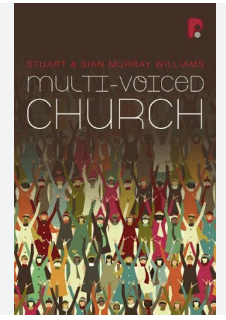
Today I was hanging out with the Mennonites and Anabaptists who were co-hosting an event entitled “Multi-voiced Church”, led by Sian and Stuart Murray Williams who co-authored a book with the same name. I have read the book and enjoyed both the style and content, so today seemed like a good opportunity to discuss the ideas of the book with others, as well as hopefully develop further some of the ideas from within the book.
Sian and Stuart were excellent course leaders. They presented their argument for multi-voiced expression and leadership of church with clarity, humour and wisdom. I appreciate the fact that both of them have experience both as leaders in churches, in teaching, and as ‘normal’ members of worshipping communities. Their reflection and learning comes out of all 3 of these areas of their lives and makes for rich experience from which to draw insight.
In our church one of our 4 values is that we are a multi-voiced church. Certainly we are far more multi-voiced than any other church that I have been part of (our church in Prague aside, but that is quite a different experience and community for many reasons) but we still need to keep working, reflecting and praying about how we can continue to see all people discovering and using the gifts, talents and passions that God has given them (both within church and outside of church).
Some particular thoughts from the day:
1. Multi-voiced church is not just about when we gather as a worshipping community together – it is about leadership, who decides what, who has power. It is about ecclesiology more than anything.
2. Framing the question about where God has been or hasn’t been in the week with verses from the Bible might help to connect people to Scripture as the over-arching story which we as Christians are caught up with. (Instead of just it being something cool that we do!)
3. Creating multi-voiced church almost certainly means that pastors and leaders of the church have to give up some of their power. It also means being vulnerable and taking risks. It does not mean that you never have sermons or that you can retire your minister (phew) but the skills of the pastor are different than if you are mostly working within a ‘mono’ voiced paradigm. My job is not to ‘do it all’ – my job is to unearth the treasure that is already there and to help polish it. (Instead of polishing my own ‘performance’.)
4. How do we have time to engage deeply with people inside church to develop disciples and make church life more multi-voiced but also have enough time to spend time with people in our neighbourhoods and communities? We don’t want to move from ‘mono-voiced’ to ‘busy mono-voiced’. How do we discern together what we are going to do and what we aren’t?
5. Discerning missional opportunities will arise naturally when we are expecting people to see God at work in their week. As leaders we can then help people to follow/develop how they share their stories, instead of us as leaders normally going to churches to get them on board with one of our ideas!
6. If people can’t talk about their faith within church then there is little chance of people sharing their faith with others outside the Christian community.
7. It is not as simple as ‘mono’ voiced and ‘multi’ voiced – obviously there are shades and combinations of each in every part of church life.
8. We need to tell more stories – both from our own lives and how God has changed/ is changing us, but also from different parts of the church, and from the Scripture. We need to learn the stories of our faith and remember them as part of our story.
A good day with much valuable learning and discussion. Catching up with old friends and new. Discussion, learning, people. Love that stuff! 🙂
* We were trying to see if there were any other better words than ‘multi-voiced’ church because of a desire to express the fact that we don’t only mean actual ‘voices’ but rather, each person having a place at the table.
 stumbling hopefully in the right direction
Leave a comment