
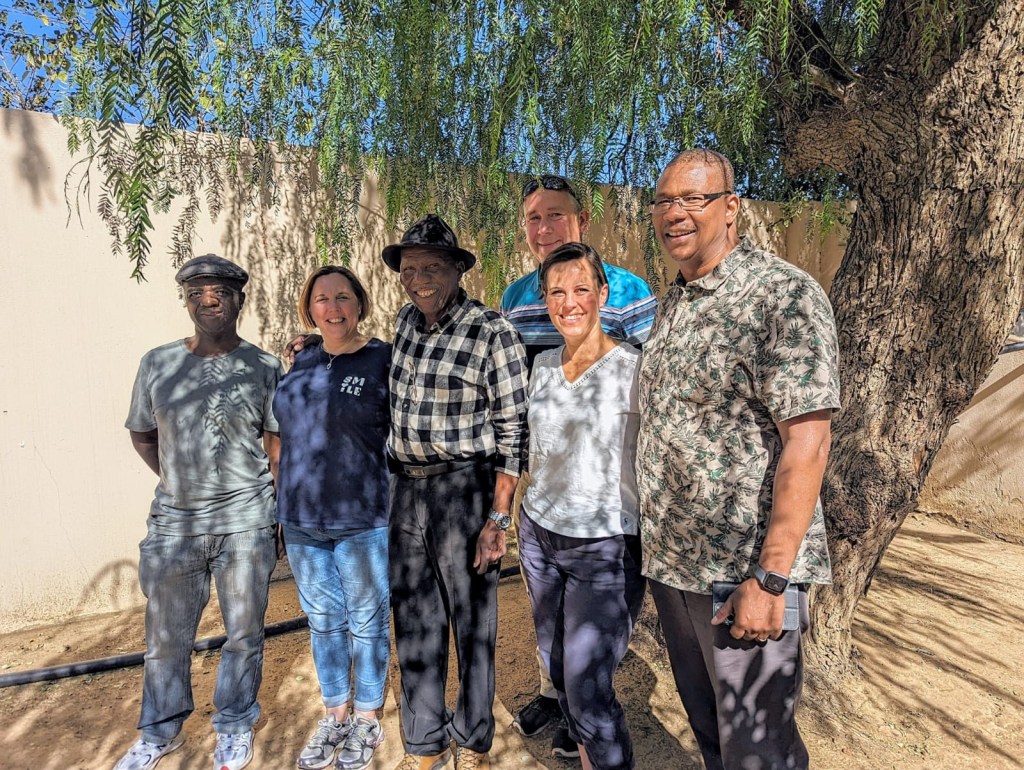
On Thursday we met with Rev Dr Ray Motsi, who is the President of the Theological College of Zimbabwe – which is co-owned by the Brethren in Christ and Baptist Union of Zimbabwe. (Themba said that Ray has been adopted into the Brethren in Christ because of his Anabaptist values!) Ray is also a cofounder and Chairperson for the Zimbabwe Christian Alliance (ZCA) – a national network of Christian leaders engaging with current issues in the public sphere from a faith-based perspective.
On initial meeting his lean, slight stature would deceive you into thinking that Ray is an old man. But as soon as you start to talk, that impression immediately leaves you – and you realise the fire that still burns within and animates this wise, passionate elder.
Ray is from the Shona people. He is a peace maker, Baptist minister, theologian, political activist and Anabaptist. He is also a storyteller and narrator. He helped us to understand more about the history of Zimbabwe – especially of the last 40 – 50 years. Violence has plagued Zimbabwe in recent decades, and it has now become the default way that people engage in resolving conflict. In the 1980s, Mugabe’s campaign of violence primarily against the Ndebele people killed over 20,000 people. “Gukurahundi” (literal translation – the wind that takes the chaff away) is now recognised as a genocidal war by international organisations. The Shona people on the whole, deny that this genocide happened. Ray talked about the pain and helplessness that he experienced as a Shona person (the people who were mostly the perpetrators of the violence on the Ndebele people) looking at the violence that was metered out on the Ndebele. His helplessness and their helplessness somehow met.
It was in trying to understand the violence meted out during this time that brought Ray to the Anabaptist story, to peace activism and a resolve to do something to bring reconciliation and healing. Ray started Grace to Heal a charity dedicated to conflict transformation, and bringing community and personal healing to the trauma which people had experienced. We were fortunate to meet Dr Dumi, the Executive Director of the charity. As well as trauma processing, Grace to Heal offers courses for women’s empowerment, youth peace building activities, work with church and community leaders and conflict resolution. They also offer academic research and release publications on peace building and reconciliation. Ray is particularly interested in developing African theologies around healing from trauma and peace making, instead of relying on Western theologies. He hopes to build a community of peacemakers who can continue to reflect on their practice and learn together.
In 2005, the government launched “Operation Murambatsvina” (Operation Clean-Up) essentially to destroy the homes and businesses of those in opposition to the government, to disrupt social cohesion and create a climate of distrust.
Ray is passionate about dealing with conflict proactively and thinking through issues of how we proactively talk about community differences, instead of retrospectively dealing with the fallout of violence. Conflict transformation is contextual and specific – so it is important to train peacemakers to be reflective practitioners in their own settings, to share stories and learn practical peace building skills to nurture cohesive communities. In his own peacemaking experience, it has been through listening to peoples’ stories, making time to acknowledge their struggles and creating space for forgiveness, that has enabled healing to take place. Ray speaks openly about the fact that he has had to wrestle with being a Shona person, and that he carries that part of identity with him. He talked about the difficulty that many people had when they met him because of their suspicion of him. Ray wanted to be a peacemaker but the fact that he was Shona was a huge challenge to that desire. How could someone who was from the side of the perpetrator be trusted?
During our travels and late night chats in the kitchen in Bulawayo, we have talked about our own individual struggles that we have had with our past – whether that is due to country of birth, history and heritage of those lands, or past character attributes. I personally continue to wrestle with what it means to be a privileged, educated white South African, who left South Africa at 15 years old nearly 30 years ago – just as the new South Africa was being born. Africa is my home, but am I allowed to say so? What does it mean? And how can Africa meaningfully be part of my future as well as my past? What is the invitation to me? In our conversation with Ray we talked about whether the hurts of the past (whether we had any choice or agency over them or not) could be considered a thorn in the flesh like Paul spoke of. Paul goes on to say that ‘my grace is sufficient for you, for my power is made perfect in weakness.’ (2 Corinthians 12: 8 10). Both Ray and Themba talked about how we all carry wounds, but that acknowledging them and moving forward to work with others together to bring about peace is really the only way forward. We are not condemned by the past. We cannot be caught up in the shame and thorn bushes of our individual past or collective history. We don’t deny the pain that has been caused, but we seek to bring healing, to offer and receive forgiveness and to work for a better, more hopeful, peaceful future. God’s grace is enough.
Ray believes that an important way of bringing healing after pain and trauma is in recognising the pain and hurt that has been caused. Memorialising the event, marking that it happened. One particularly powerful story which Ray shared was an event that he organised in 2007 to mark the lives that had been affected particularly during “Operation Clean-up.” This memorialisation was to take the shape of a march. He organised the march, applied for and was granted police clearance. The route for the march was run between St Patrick’s Church in Bulawayo and the central Brethren in Christ church in the city. The night before the march was organised the police phoned Ray and said that it had to be cancelled. Ray said that people would still be gathering because it was such short notice, and anyway, he would have to be there to tell people in person that the march was cancelled, so he would still be going to St Patrick’s church on Saturday morning at 7am. The police warned him that there would be armed officers at the meeting point. Ray replied that as it would be daylight anyway, if he was shot then people would know who shot him!
Early the next morning, Ray and the many people who gathered to march, arrived at the church. He got up and addressed the crowd, telling them that unfortunately, the march had to be cancelled. However, as they were meeting at St Patrick’s church, and processing to the BIC church for their prayer meeting, they would start their prayer gathering here, and continue to prayer walk to the BIC for their church gathering there. Fortunately, the police were there to make sure that they all arrived there in safety, for which he thanked them!
Ray has been imprisoned for treason and continues to be outspoken about the government’s lack of transparency and reparations to engage with victims of the Gukurahundi.
Many of the stories that were shared today were poignant, heartbreaking and strikingly recent. Within the lifetimes and memories of many people. Although the memories are faded, talking about the events brings the pain of those past disturbances to mind. The government has never taken responsibility for their state-sponsored violence, nor have they initiated any kind of Truth and Reconciliation Commission similar to that of South Africa after the trauma of apartheid. It is up to churches and charities to do the work of bringing healing to individuals, communities and society. Our conversation with Ray and Dumi gave us much to think on and talk about. Our conversation felt like just the tip of the iceberg of passion, knowledge and possible collaboration and mutual learning. We hope to continue to connect with Ray to share and learn more about how we embed peacemaking in our everyday interactions, as well as build stronger, more resilient communities through peace building practices and conflict transformation.
 stumbling hopefully in the right direction
Leave a comment